

Our colleges of law do not hold a place of high esteem either at home or abroad, nor has law become an area of profound scholarship and enlightened research.” These words, said by Dr. S. Radhakrishnan decades ago, remain uncomfortably relevant today. Despite the proliferation of law schools across India and the emergence of the National Law School model, the legal education system continues to churn out graduates who feel like strangers when they enter the courtroom for the first time.
India’s modern legal education traces its origins to 1855, when the first law professorship was established at Government Elphinstone College in Bombay. The Bar Council of India, constituted under the Advocates Act of 1961, is the apex regulatory body tasked with maintaining standards. It prescribes the curriculum, sets minimum qualifications, and recognizes university degrees. Yet for all this regulatory architecture, the quality of legal education across most institutions remains poor.
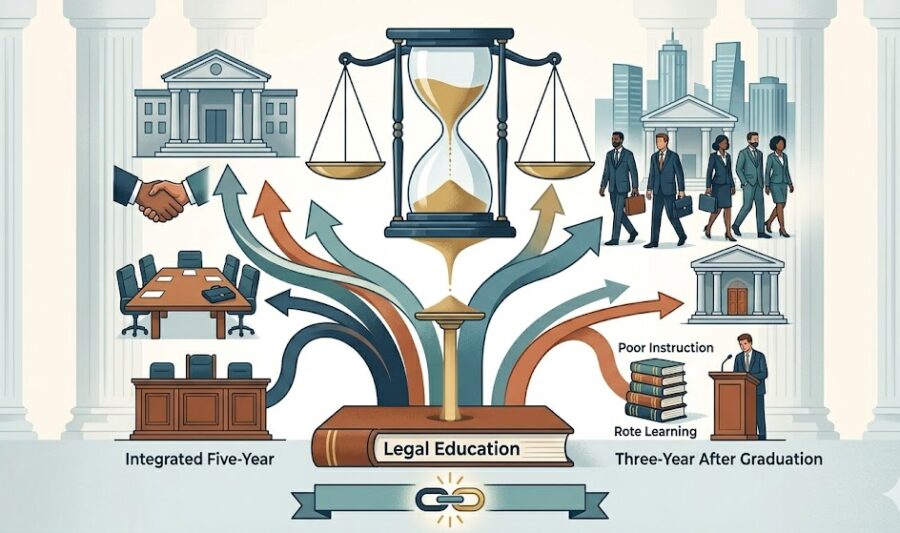
Today’s legal education is offered through two routes , a three-year LLB after graduation, and an integrated five-year BA LLB after Class XII. Both have merits and drawbacks. The five-year course offers deeper immersion, practical exposure through moot courts, and international outlook. But graduates from elite National Law Schools rarely join the bar, they prefer corporate law firms with their attractive pay packages, leaving the district courts and trial courts understaffed with skilled advocates.
The three-year course, by contrast, tends to attract working professionals and those with more practical ambitions. But it too is plagued by poor instruction, rote learning, and a curriculum that has not kept pace with the demands of a globalizing world. New subjects , cyber law, environmental law, intellectual property , have been added, but at the cost of adequate depth in foundational subjects like contract, tort, and constitutional law.
What India needs is not more law schools, but better ones. Curriculum reform should prioritize clinical legal education, drafting skills, alternative dispute resolution, and exposure to international law. Law teachers should have regular interaction with practicing lawyers. Quality assessment through independent accreditation is long overdue. And young lawyers should be meaningfully supported in their early years through legal aid programmes and mentorship.
The rule of law is only as strong as the lawyers who uphold it. If we continue to produce graduates who cannot draft a simple pleading, we do not merely fail the legal profession , we fail justice itself.