
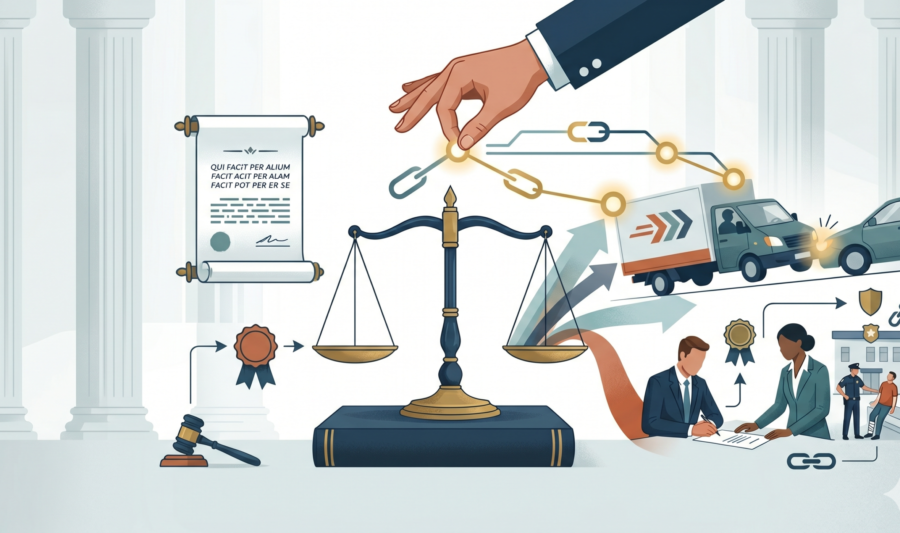
In law, the general rule is simple: you answer for your own actions. But life rarely fits neat categories. What happens when a driver, acting on his employer’s orders, injures someone on the road? Or when a corporate director’s decisions lead to fraud? This is where vicarious liability steps in , the legal principle that holds one person responsible for the wrongful acts of another, arising from a special relationship between them.
The concept finds its roots in the Latin maxim “qui facit per alium facit per se” , he who acts through another acts himself. Three key relationships give rise to this liability: master and servant, principal and agent, and employer and independent contractor. For liability to attach, there must be an established relationship between the parties, a wrongful act must be committed, and that act must occur within the scope of employment.
Courts across centuries have wrestled with where exactly this liability begins and ends. In the landmark 1862 case of Limpus v. London General Omnibus Company, an omnibus driver who deliberately obstructed a rival vehicle was found to have been acting within the course of his employment , making his employer liable, despite written instructions to the contrary. Similarly, in Mersey Docks v. Coggins & Griffith (1947), the House of Lords held that the original employer remained liable even when a crane driver was temporarily lent to another company.
In India, the Supreme Court’s ruling in Sunil Bharti Mittal v. CBI (2015) clarified that corporate directors cannot automatically be held vicariously liable for a company’s criminal acts without specific allegations of personal involvement. Courts have consistently held that criminal vicarious liability requires explicit statutory language , it cannot simply be implied. The doctrine also extends to the State. Governments are not immune from liability for wrongs committed by their servants, provided those acts fall outside the exercise of sovereign powers. Cases like Saheli v. Commissioner of Police, where the Delhi Administration was held liable for a death caused by police brutality, show that the State must remain accountable for the conduct of those who wield its authority.
Vicarious liability ultimately serves a protective function. When those who cause harm lack the means to compensate victims, the law looks to those who commanded or benefited from their actions. It is a doctrine rooted in both fairness and practical justice , ensuring that power and responsibility walk hand in hand.